What FLGR-242 is, and why calling it a peptide is wrong
FLGR-242 is a recombinant glycoprotein of roughly 40 kDa, and that number decides most of what follows. A short synthetic peptide is a chain of a few dozen amino acids built on a solid support and cleaned up on a column. A 40 kDa construct is expressed in living cells, folded, glycosylated and purified as a protein. Different manufacturing worlds, different assays, different failure modes. The catalogue sells it beside 5 mg peptide vials, and shelf placement is all the two have in common.
The vendor is BioLongevity Labs, which lists it as FLGR242 5mg Research Peptide. Its own description is specific enough to check: a fragmented, modified version of follistatin-344 that, in its words, "does not bind to the protein activin", carrying "a patented albumin binder" and a glycine-serine linker that binds serum albumin below 20 nM Kd. The linker is printed on the listing as GGSGGSGGSGGRLIEDICLPRWGCLWEDD, and the synonyms offered are FST-Albumin Construct and Extended Half-Life Follistatin.
That second synonym names what the albumin binder is for, and it is the most informative line on the page. What the listing never supplies is a measurement of that half-life, in any species, from any source. Published: a weight, an affinity, a sequence and a manufacturing claim. The table below marks which of those a reader can actually confirm.
| Vendor-stated property | Value on the listing | What a reader can verify |
|---|---|---|
| Type | Follistatin-albumin binding construct | Nothing independently; the description is the only source |
| Molecular weight | About 40 kDa | That this is a recombinant protein, not a synthesised peptide |
| Linker sequence | GGSGGSGGSGGRLIEDICLPRWGCLWEDD | That a sequence is published at all, which most listings skip |
| Albumin binding affinity | Under 20 nM Kd | Nothing; no assay report is published for this product |
| Synonyms given | FST-Albumin Construct, Extended Half-Life Follistatin | The design intent, which is a longer circulating half-life |
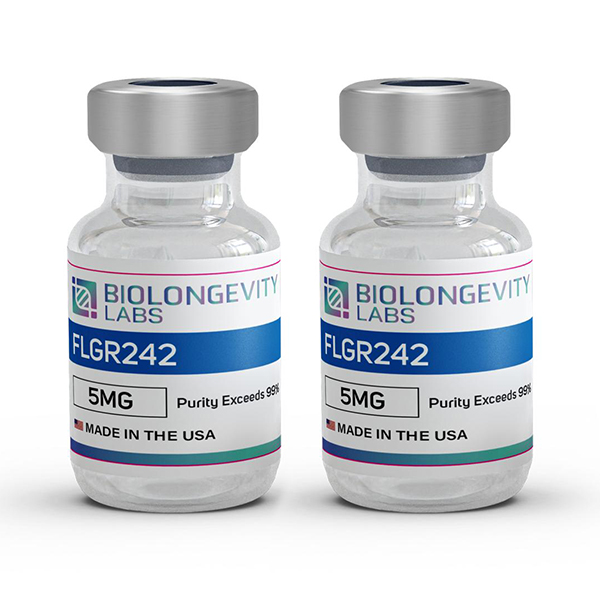
| Vial and pack | 5 mg per vial, sold as pairs of two vials, 10 mg | What arrives, and that pricing is per pair rather than per vial |
| Manufacturing | US GMP, third-party verified | Nothing; no third-party report for this product is public |
| Activin binding | Stated three different ways on one page | Nothing, and this is the unresolved item that matters most |
Every value in the middle column is the vendor's own, taken from the product listing on 8 September 2026.
FLGR-242 for sale: what $499.00 buys, and the code
FLGR-242 sells in pairs rather than by the vial. One pair is two 5 mg vials, 10 mg in total, listed at $499.00, checked on 8 September 2026. Volume tiers start at 5 percent off for six pairs and reach 20 percent at forty-eight, the largest pack being 96 vials at up to $19,161.60 list. The discount code is Peptidedeck, entered at checkout. We have not verified what percentage it returns, so this page does not state one.
A sitewide banner sale was running when the price was checked, showing $249.50 for the same pair. Sales end and this page does not, so plan against the $499.00 list and treat anything lower as weather rather than as the price.
Check the current FLGR-242 listing at BioLongevity Labs, and enter Peptidedeck at checkout. That is an affiliate link and we may earn a commission at no cost to you. Research material, laboratory use only, not for human consumption. It is not a recommendation to buy, and the three problems below are why.
| The offer, as listed | Detail |
|---|---|
| Product name | FLGR242 5mg Research Peptide, sold by BioLongevity Labs |
| One pair | Two 5 mg vials, 10 mg in total |
| List price, one pair | $499.00 |
| Discount code | Peptidedeck, entered at checkout |
| Volume tiers | 5% at 6 pairs, 10% at 12, 15% at 24, 20% at 48 |
| Largest pack listed | 48 pairs, 96 vials, up to $19,161.60 list |
| Price checked | 8 September 2026 |
| Regulatory status | Research material; not approved as a medicine in any country |
Prices checked 8 September 2026. A sitewide sale was running at the time, and sale pricing is temporary.
FLGR-242 vs follistatin-344: what carried over and what did not
Follistatin-344 is the parent. FLGR-242 is described by its seller as a fragmented, modified version of it with an albumin binder attached, which is three changes in one sentence: something removed, something altered, something added. Each is a reason the two are not interchangeable, and a reason the parent's literature does not travel across on its own.
The comparison a reader wants is potency and duration against the parent, and neither number exists in public. No published measurement sets FLGR-242 beside follistatin-344 in any system, cell or animal. Every quantity attached to the name came from the party selling it.
That is ordinary for a proprietary construct rather than a scandal. A modified molecule under a house code is a new entity until somebody characterises it. The problem is narrower: the page presents the parent's evidence as though that characterisation had already happened.
The activin contradiction, printed three times on one page
Read the product page top to bottom and it says three different things about activin. The description states that FLGR242 "does not bind to the protein activin". The meta description and social card say it is "Studied for myostatin inhibition and activin binding". The research applications section, further down that same page, lists "activin neutralisation assays".
This is not a quarrel about wording. Follistatin's established mechanism is high-affinity binding and neutralisation of activins and related TGF-beta ligands. A construct that genuinely did not bind activin would be a substantially different molecule from its parent, and that is a large claim needing evidence rather than a line of product copy. The same page then offers the material for activin neutralisation assays, which is the experiment you run on something that binds activin.
Both cannot be true, and the difference decides what the vial is for. A buyer cannot settle it from the listing, and nothing published elsewhere settles it either. The likeliest explanation is dull, marketing copy written separately from the technical description with nobody reconciling the two, and that explanation is itself the finding. A vendor whose page disagrees with itself about the defining property of the molecule has told you something about its internal checking that no certificate would.
The certificate that is advertised and not published
The listing title says COA Included and the description promises comprehensive COAs. The vendor also runs a public certificate library, and on 8 September 2026 it held eight PDFs, not one of them covering follistatin or FLGR242. The eight are a Cortagen certificate plus endotoxin reports for BPC-157 and TB-500, CJC-1295 and ipamorelin, DSIP, retatrutide, SS-31 and tesamorelin. Count them yourself at the vendor's public COA library.
A certificate that exists only after purchase cannot be used at the moment it would help. Reading the document before paying is the document's entire function. Afterwards it leaves you arguing for a refund on a vial you already own.
Notice what leans on the missing file. The manufacturing claim is US GMP and third-party verified, and third-party verification is a statement about a report. For this product the report is the thing not published, so the claim reduces to the seller vouching for the seller. The vendor plainly can publish certificates, because it publishes eight. None of them is this one.
What the published literature says about FLGR-242
Nothing at all. PubMed returns zero results for FLGR-242 and zero for FLGR242. ClinicalTrials.gov returns zero records. No published characterisation, no animal study, no human study, no independent assay under either spelling.
The listing does carry twelve references, and they are real papers. We verified a sample: systemic administration of follistatin288 increasing muscle mass, PMID 23942549, published 2013 in mice; nanoparticle-mediated hepatic delivery of follistatin mRNA, PMID 30555546, 2018, in mice; follistatin in non-alcoholic fatty liver disease acting through mTOR, PMID 36325432, 2022.
None of them studied FLGR-242. They studied follistatin. Placing a reference list about a protein family beneath a product name is how a proprietary construct borrows an evidence base it has not earned. The citations are not fabricated, which deserves saying plainly, and they are also not about the contents of the vial.
The test generalises and takes one search. Put the product name into PubMed and see whether the cited papers come back. Here not one of them contains the name.
What a prescribed biologic has to prove before anyone can buy it
This is a recombinant protein therapeutic in everything except status, so the fair comparison is not against a supplement. It is against a prescribed biologic, and the gap is less about whether either works than about what has to exist on paper before a sale is permitted at all.
A licensed biologic reaches a patient having demonstrated identity, meaning the sponsor proved by more than one analytical method that the molecule is what the label says, batch after batch. It carries a characterised purity and aggregation profile, because aggregated protein is the specific failure mode of this class. It carries immunogenicity data, because a modified or foreign protein can provoke antibodies that neutralise it and, at worst, the body's own version with it. It arrives with an indication an authority had the power to refuse, a leaflet of known harms drawn from human exposure, a recall route that reaches whoever is holding the box, and a reporting system able to see harm across a population.
FLGR-242 has none of that, and in fairness the vendor does not claim otherwise. It holds no marketing authorisation anywhere and is sold as research material. Against a prescribed biologic it is missing not a document but the whole dossier, and the price is not the surprising part. $499.00 for 10 mg is real money for a molecule whose defining property is described two contradictory ways on the page selling it.
None of this implies the regulated route is available instead. It is not: no clinic or pharmacy in any country can dispense this, because it is not a medicine in any country. Holding the two up together makes visible what a buyer is declining, since those protections arrive silently with the box and are never listed as benefits. Decline them and the liability that sat with a manufacturer sits with the buyer.
| What has to exist before sale | A prescribed biologic | FLGR-242 as sold |
|---|---|---|
| Proof of identity, batch by batch | Required, by more than one analytical method | Certificate advertised, none published for this product |
| Purity and aggregation profile | Characterised and specified | Not published |
| Immunogenicity data | Required before approval | None; no human has been studied |
| Evidence it does anything | Controlled human trials in a defined condition | Zero results on PubMed and ClinicalTrials.gov |
| An approved indication | Granted by an authority with power to refuse | None, in any country |
| A list of known harms | Published leaflet drawn from human exposure | No human safety data of any kind |
| A recall route | Regulated, and able to reach the buyer | None |
| Who carries the liability | Manufacturer and prescriber | The buyer |
FLGR-242 review: what is settled and what is not
Settled, and not in dispute: the product exists and is sold, it is a roughly 40 kDa follistatin-albumin fusion construct rather than a short peptide, one pair is 10 mg across two vials at $499.00 list, the code Peptidedeck goes in at checkout, and the vendor publishes a linker sequence and an albumin affinity, which is more disclosure than many listings offer.
Not settled, and each item checkable rather than a matter of taste: whether the construct binds activin, because the page says both; whether any certificate of analysis exists for this product, because the public library holds none; and whether it does anything in any species, because no literature under the name exists.
Those are three questions the vendor could answer in an afternoon. Publish the certificate for the lot currently shipping. Correct whichever activin sentence is wrong. Publish one characterisation of the construct itself rather than of follistatin. Until then the honest description of FLGR-242 is a well-specified idea with an unpublished file behind it, sold at biologic prices without the biologic's paperwork.