Peptides for dogs: two different products, one search phrase
Ask about peptides for dogs and you are really asking two questions with opposite answers, because the phrase covers two products that share a chemistry and nothing else. Telling them apart is the whole of this page.
Start with the correction, because it is the more useful half. It is not true that peptides are unapproved for dogs. Insulin is a peptide, and Vetsulin, a porcine insulin zinc suspension, is described by its manufacturer as the first FDA approved insulin for use in dogs and cats with diabetes. So the honest sentence is narrower and sharper: some peptide medicines are approved for dogs, and none of the ones sold on research chemical websites are among them.
The other product is a sealed vial of freeze dried powder, ordered from a website in two minutes with a card. It carries a compound name, a lot number, and a line of legal text saying it is for laboratory research only and not for human or animal consumption. It does not carry a species, an indication, directions for use, or the name of anyone who has seen your dog. That is not an oversight. It is the condition on which the sale is lawful.
This page carries no product offer, though other pages on this site do and our affiliate disclosure explains how that works. The reason is simple. Its reader is deciding what to put into an animal that cannot consent, refuse, or say that something feels wrong.
What you are actually buying, and from whom
Look at the transaction rather than the compound, because the transaction is where the risk lives. You visit a website. Nobody asks what animal this is for, what it weighs, what else it is taking, or whether it has a condition the compound would worsen. There is no eligibility screen because there is no eligibility criterion: on the seller's own paperwork, the vial is going onto a bench, not into a living thing.
That research labelling is a legal statement about the transaction, not a description of the powder or a comment on its quality. It is the sentence that makes the sale lawful. It also means the seller has stated in writing that the product is not for your dog.
Then run the two in the morning test. Your dog is unsettled, the injection site is swollen, and the practice is closed. Who do you call? Not the supplier. A research peptide company has a shipping desk, not a clinical one. It cannot take an adverse event report into any system a regulator reads, it holds no record that your dog exists, and it owes no duty of care to an animal it was never told about. The prescriber you did not use is the person who would have answered.
The same missing scaffolding appears whenever a compound is bought outside a prescribing relationship. Our breakdown of what the absence of a prescription actually removes works through that gap on the compound most often raised for dogs. What is different here is that the patient cannot describe a symptom.
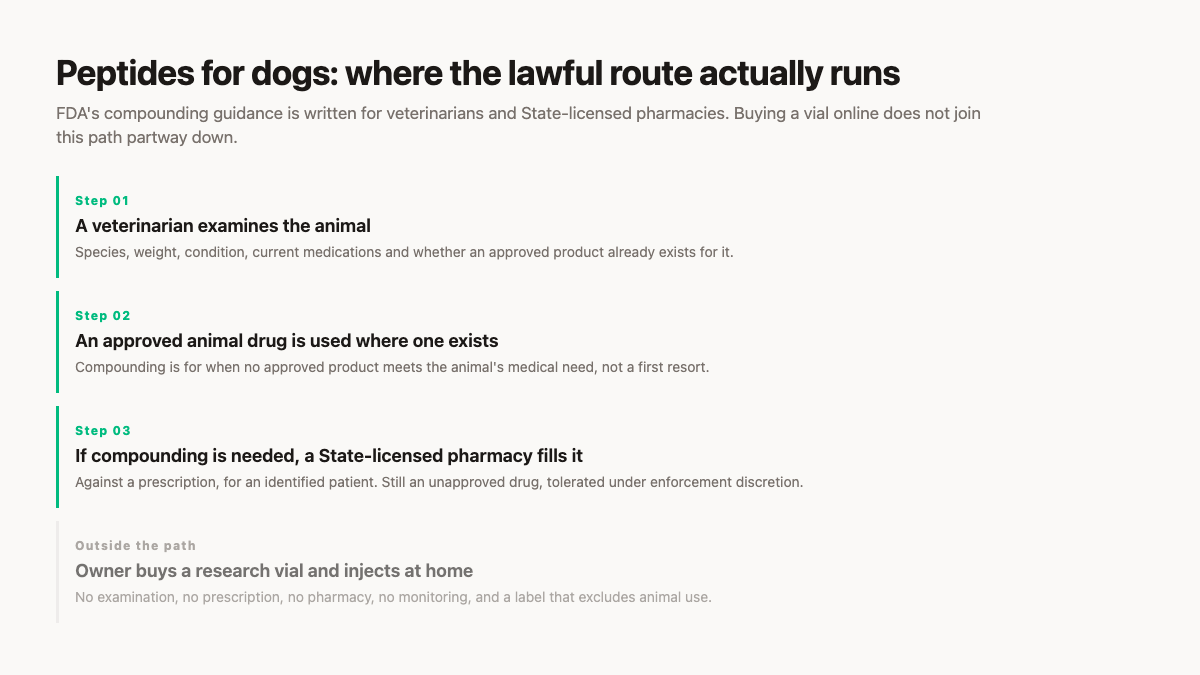
Where a peptide medicine for a dog can lawfully come from
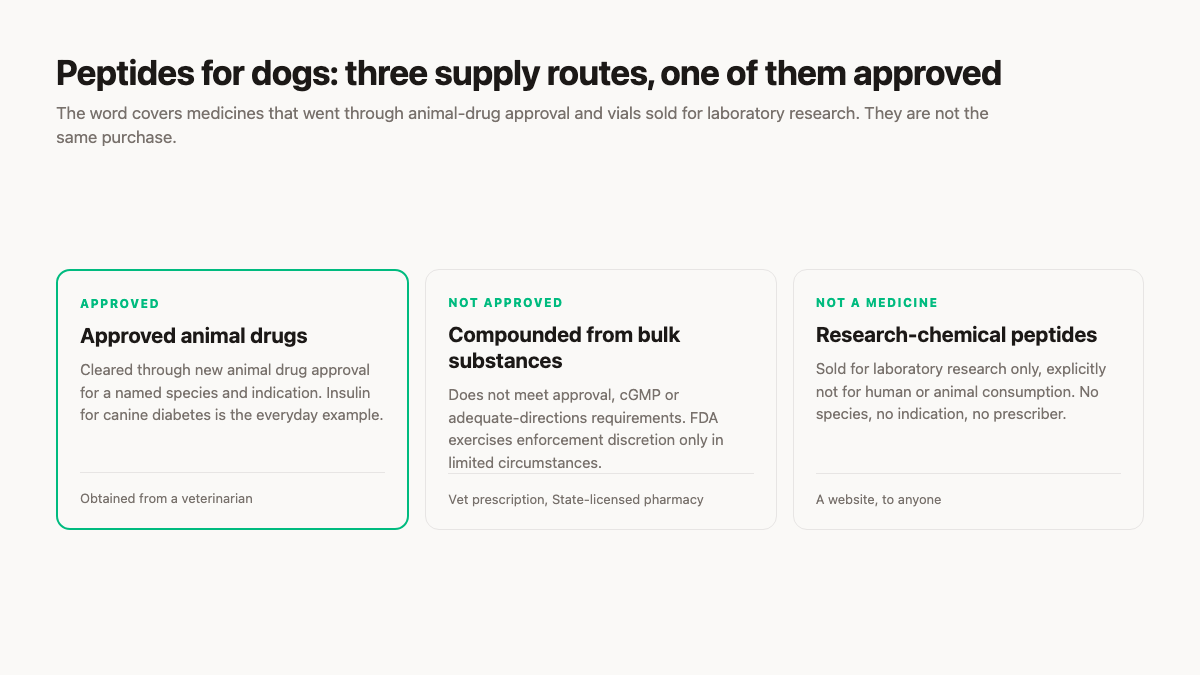
There are three supply routes and they are not variations on a theme. Two of them run through people who carry obligations to your dog. The third runs through no one.
The first is an approved animal drug, which arrives with an indication and directions for use. The second is compounding from a bulk drug substance, and it is the one most often misdescribed as a loophole. FDA's Center for Veterinary Medicine addresses it in Guidance for Industry #256, Compounding Animal Drugs from Bulk Drug Substances, docket FDA-2018-D-4533, and is plain about what compounding is not: "Animal drugs that are compounded from bulk drug substances do not meet the FD&C Act's new animal drug approval, cGMP, or adequate directions for use requirements. However, FDA has generally exercised enforcement discretion with regard to animal drug compounding from bulk drug substances under certain circumstances." The full text sits on FDA's guidance page for CVM GFI #256.
Two things follow. The first is who the guidance is for. FDA states it is intended for veterinarians, State licensed pharmacies and Federal facilities, compounding for use in nonfood producing animals. A dog is a nonfood producing animal, so the pathway does reach dogs, but only through a veterinarian and a licensed pharmacy. An owner ordering a vial from a website is not on it at all.
The second is what enforcement discretion actually is. FDA describes circumstances in which, at this time and based on its current understanding of the risks, it does not intend to take enforcement action. That is a stated posture, conditional and revocable. It is not approval, and it is not something a website can claim on your behalf. We have written about how quickly a compounding position can move.
| Supply route | Regulatory status | Who supplies it | Who answers if it goes wrong |
|---|---|---|---|
| Approved animal drug | Approved, with a species, indication and directions for use | A veterinarian, filled by a pharmacy | A prescriber who examined the animal, an answerable manufacturer, a reporting route |
| Compounded from a bulk drug substance | Not approved. FDA describes exercising enforcement discretion under certain circumstances | A veterinarian's prescription, filled by a State licensed pharmacy | A prescriber and a licensed pharmacist, both identifiable and accountable |
| Research chemical peptide | Outside the pathway. Sold as laboratory material, not for human or animal consumption | A website, to anyone, no questions asked | A shipping desk and a label saying the product was never for your dog |
Characterisations follow FDA CVM Guidance for Industry #256, docket FDA-2018-D-4533.
What the evidence contains, and who is claiming what
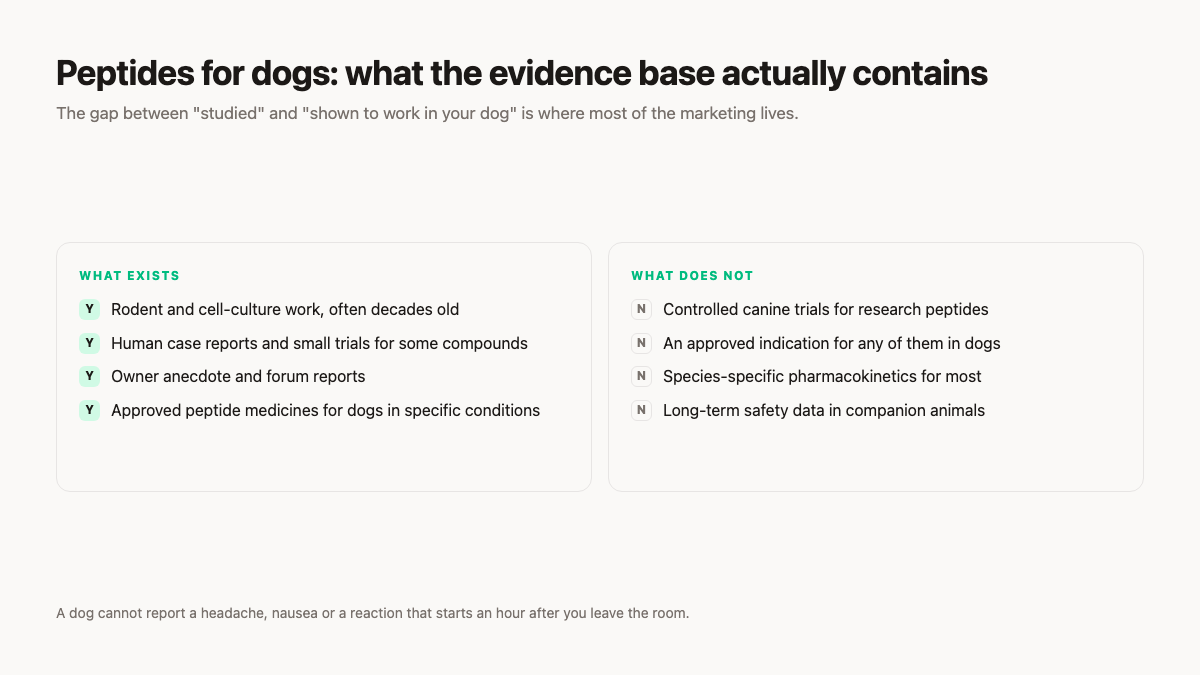
BPC-157 is the compound most often raised for dogs, usually for soft tissue or gut complaints, and the claims are made with a confidence the underlying work does not support. That work is overwhelmingly rodent studies, in vitro experiments and owner anecdote. Attribution matters here: the strong claims come from sellers and from owners describing single animals, not from veterinary researchers reporting controlled trials in dogs, because those trials are not there to report.
That absence is the finding. There is no approved indication for any of these compounds in dogs, and no adequate canine evidence base for efficacy or for safety. An anecdote about one dog that improved cannot separate the compound from rest, from time, from the other medication the dog was on, or from a problem that was going to settle anyway.
Nor is it available to borrow the human literature and scale it down. Species differ in absorption, in clearance, and in what an off target effect looks like. A human volunteer reports a symptom on day two. A dog goes quiet, and quiet reads as calm until it does not.
If you want a compound by compound breakdown of what gets discussed in this space, PeptideDeck keeps a longer reference page on peptides for dogs. It includes dosing figures. This page does not reproduce them, for the reason below.
Why there is no dose on this page
Nothing above tells you how much of anything to give an animal, and that is deliberate rather than squeamish. A dose is not a property of a compound. It is the output of a clinical judgement about a specific animal, its weight, age, organ function and other medications, about the real concentration in the vial after someone reconstituted it, and about whether treating at all is the right call. Remove any one of those and a number stops meaning anything.
A certificate of analysis does not fill that gap, though it is the document sellers point at when the question gets uncomfortable. A good certificate tells you real things about one batch: identity confirmed, purity against a stated specification, heavy metals screened, an endotoxin result against a limit, and a sterility screen showing no growth. Endotoxin testing under USP Chapter 85 is not a formality when the intended route is injection.
But read what the certificate is scoped to. It describes a batch of powder as it left a laboratory. It says nothing about whether the substance is safe in a dog, because nobody tested that, and nothing about what happened in transit or how sterile a kitchen table is. Our guide to reading a certificate without over reading it works through the same distinction. A clean batch is evidence of a well made batch, not of a safe medicine, and certainly not a dose.
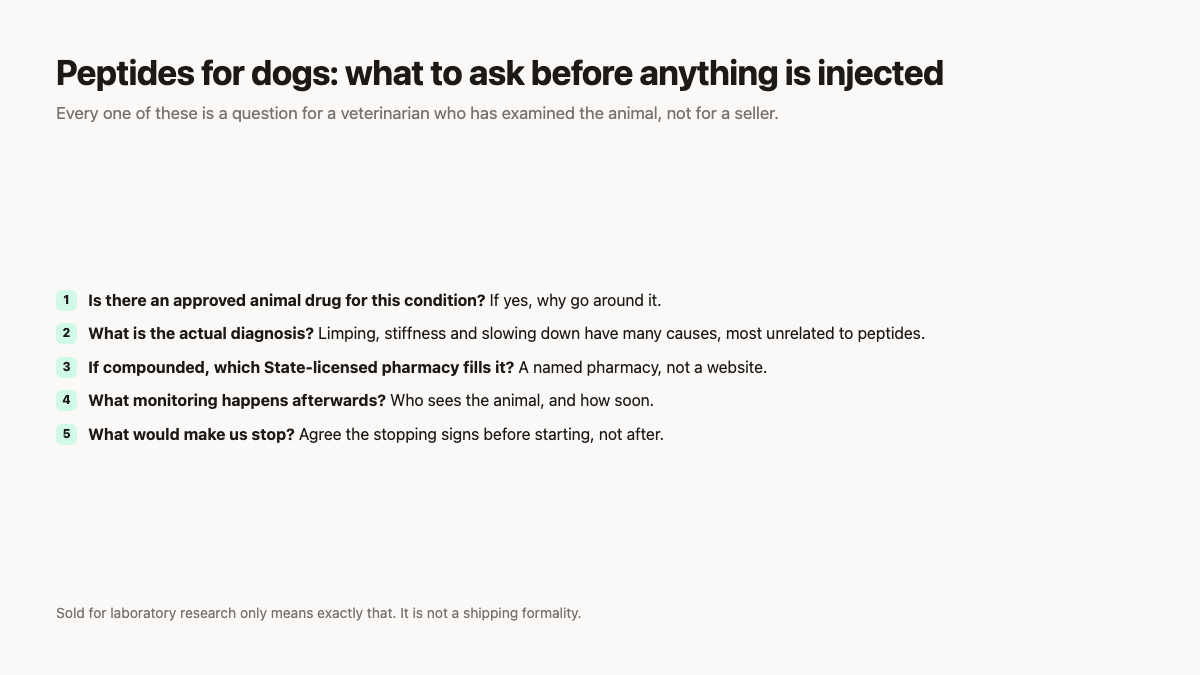
Five questions to ask before anything is injected
Every honest route through this subject ends in the same place, and not because a disclaimer requires it. It ends there because a veterinarian is the only participant who examines your dog, is accountable for what happens to it, and can be reached at two in the morning. A supplier occupies none of those roles.
So take the problem rather than the compound. Owners usually arrive at a peptide because something real is wrong: a limp that will not settle, a gut that will not calm, an old dog slowing in a way that is hard to watch. Describe that and let the diagnosis come first. Arriving with a molecule already chosen skips the possibility that an approved veterinary drug exists for exactly this, which it often does.
Then ask five things, none of them about a number. First, is there an approved animal drug for this problem in this species? Second, if there is not, is compounding appropriate here, and which State licensed pharmacy would prepare it? Third, what are we monitoring, and how will we know within weeks whether this is working? Fourth, what does a bad reaction look like in a dog, and who do I call outside surgery hours? Fifth, what is the plan if this does not work, and at what point do we stop?
A veterinarian with good answers has already done work you cannot do from a product page. One who treats the questions as an imposition has answered them too. Either way you leave with what no website can sell you: a named person who knows your dog and picks up the phone.