Retatrutide vs Mounjaro vs Zepbound in one paragraph
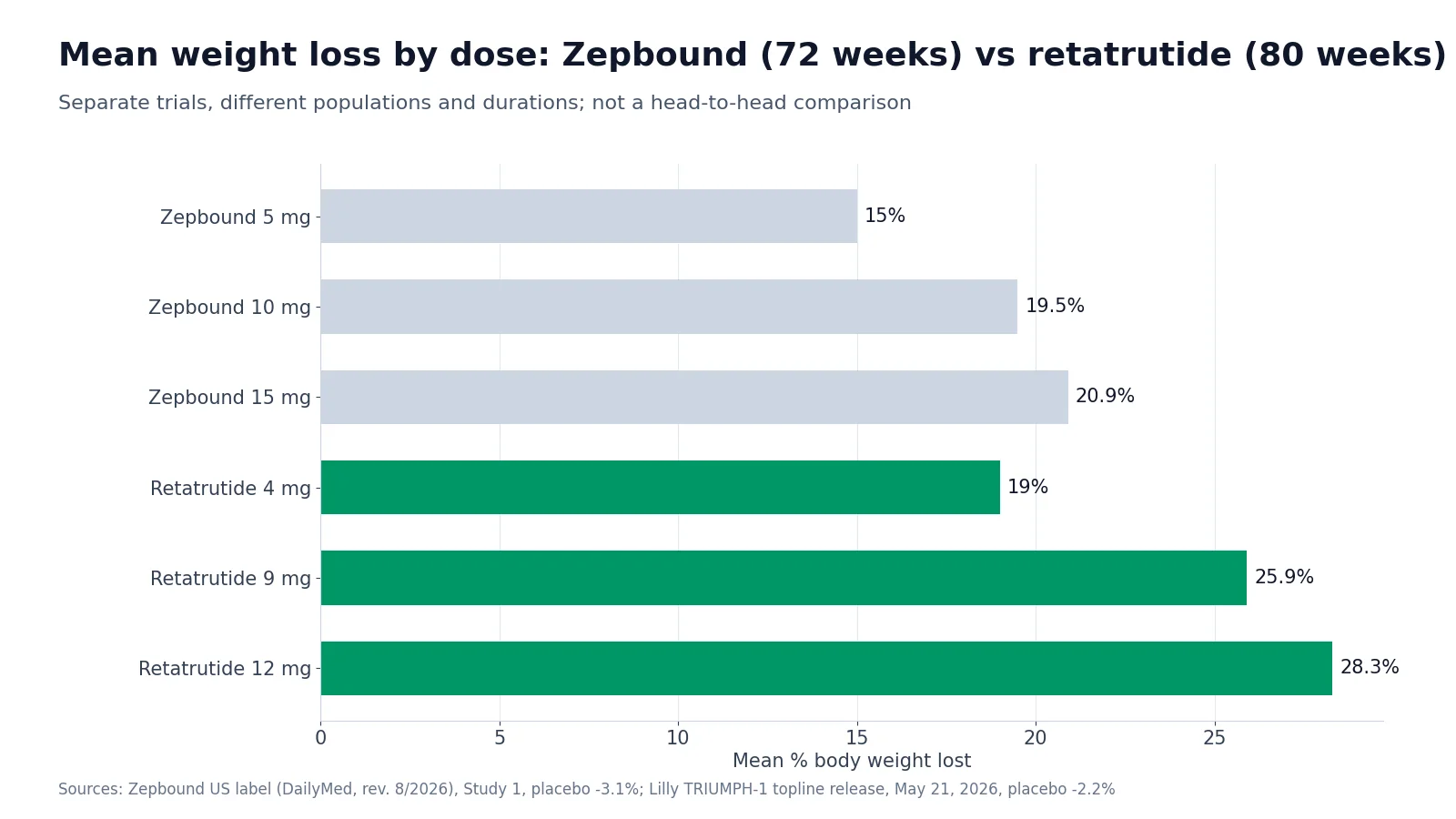
Retatrutide acts on three hormone receptors (GIP, GLP-1 and glucagon). Mounjaro and Zepbound contain tirzepatide, which acts on two (GIP and GLP-1). In Eli Lilly's phase 3 TRIUMPH-1 trial, the highest retatrutide dose produced a mean 28.3% weight loss at 80 weeks. The Zepbound label reports 20.9% at 72 weeks for its top dose of 15 mg. Those numbers come from different trials, so they suggest a gap rather than prove one.
The bigger difference for a buyer is status. Mounjaro and Zepbound carry FDA labels, a prescriber, a pharmacy and a documented dose schedule. Retatrutide has none of those. As of November 5, 2026 it has not been approved anywhere, and Lilly has said it plans to file for FDA approval in the first quarter of 2027. This page lays out what each product is, what the data does and does not show, and what that means if you are weighing a prescription programme against a research purchase.
Triple vs dual agonist, and why Mounjaro and Zepbound are one drug
Both drugs mimic GIP and GLP-1, gut hormones that lower appetite and slow digestion. Retatrutide adds a third target, the glucagon receptor. Glucagon signalling is thought to raise energy expenditure and act on the liver, which is the mechanistic argument for why a triple agonist might do more than a dual one. That is a hypothesis supported by the trial results, not a settled explanation, and it is worth keeping the two apart.
For a plain-language walk through the mechanism, see our explainer on what retatrutide is. The practical point here is narrower: the extra receptor is the reason this molecule is in a different development class from tirzepatide, and also the reason its side-effect profile is being watched more closely.
People searching for retatrutide vs Mounjaro and retatrutide vs Zepbound are usually comparing against one molecule. Both brand names are tirzepatide, made by the same company. The difference is the indication on the label. The Mounjaro label (revised 8/2026 on DailyMed) covers improving blood sugar control in adults and children 10 and older with type 2 diabetes, and reducing major cardiovascular events in adults with type 2 diabetes at high risk. Weight loss is not a listed indication.
The Zepbound label (also revised 8/2026) covers reducing excess body weight and maintaining the loss long term in adults with obesity, or with overweight plus a weight-related condition, and treating moderate to severe obstructive sleep apnea in adults with obesity. Both labels carry a boxed warning about thyroid C-cell tumors seen in rats, and both are contraindicated with a personal or family history of medullary thyroid carcinoma or MEN 2.
So the honest answer to retatrutide vs Mounjaro is the same as retatrutide vs Zepbound on efficacy, and different on indication. A doctor can prescribe either brand, but the label that matches a weight-loss goal is Zepbound. Our guide to paying less for Zepbound covers the access side.
| Retatrutide | Mounjaro | Zepbound | |
|---|---|---|---|
| Molecule | Retatrutide (triple agonist: GIP, GLP-1, glucagon) | Tirzepatide (dual agonist: GIP, GLP-1) | Tirzepatide (dual agonist: GIP, GLP-1) |
| FDA status | Investigational, not approved | Approved | Approved |
| Labelled use | None | Type 2 diabetes; cardiovascular risk reduction in type 2 diabetes | Weight management; obstructive sleep apnea |
| Start dose | 2 mg weekly in TRIUMPH-1 (trial only) | 2.5 mg weekly | 2.5 mg weekly |
| Highest dose studied or labelled | 12 mg weekly (trial) | 15 mg weekly (adults) | 15 mg weekly |
| Obtainable lawfully | Only inside a clinical trial | By prescription | By prescription |
Mounjaro and Zepbound: DailyMed labels revised 8/2026. Retatrutide: Lilly TRIUMPH-1 release (May 21, 2026) and Jastreboff et al., NEJM 2023.
What the trials show, and why the comparison is indirect
The strongest retatrutide numbers so far come from TRIUMPH-1, which Lilly announced on May 21, 2026: 2,339 adults with obesity, randomized to retatrutide 4 mg, 9 mg, 12 mg or placebo. At 80 weeks the arms lost a mean 19.0%, 25.9% and 28.3% of body weight, against 2.2% on placebo. Earlier, the 2023 phase 2 trial (Jastreboff et al., NEJM, NCT04881760) reported 24.2% at 48 weeks on 12 mg versus 2.1% on placebo.
In a further trial announced July 23, 2026, TRIUMPH-2 (1,152 adults with type 2 diabetes and obesity) reported 12.7%, 19.1% and 20.8% at 80 weeks across the three doses, against 4.0% on placebo. TRIUMPH-4 (NCT05869903, adults with obesity and knee osteoarthritis) reported 28.7% at 12 mg after 68 weeks. All of these are Lilly topline results. Detailed peer-reviewed publications for the phase 3 programme were still to come when we checked.
The tirzepatide side comes straight from the Zepbound label. In adults without diabetes, the 72-week means were 15.0% (5 mg), 19.5% (10 mg) and 20.9% (15 mg), versus 3.1% on placebo. In adults with type 2 diabetes the label reports 12.8% (10 mg) and 14.7% (15 mg) against 3.2%. The Mounjaro label adds a type 2 diabetes comparison: in SURPASS-2 at 40 weeks, tirzepatide 15 mg lowered A1C by 2.3 points and body weight by 11.2 kg, against 1.9 points and 5.7 kg for semaglutide 1 mg.
The caveat that matters: these are separate trials with different lengths (80 weeks vs 72), different populations and different designs. We found no announced head-to-head trial of retatrutide against tirzepatide. Lilly has reported one against Ozempic 2 mg in type 2 diabetes (announced October 28, 2026), which says something about retatrutide versus semaglutide but nothing direct about Mounjaro or Zepbound.
| Agent and dose | Trial and length | Mean weight change | Placebo in same trial |
|---|---|---|---|
| Zepbound 5 mg | Label Study 1, 72 weeks | 15.0% | 3.1% |
| Zepbound 10 mg | Label Study 1, 72 weeks | 19.5% | 3.1% |
| Zepbound 15 mg | Label Study 1, 72 weeks | 20.9% | 3.1% |
| Retatrutide 4 mg | TRIUMPH-1, 80 weeks | 19.0% | 2.2% |
| Retatrutide 9 mg | TRIUMPH-1, 80 weeks | 25.9% | 2.2% |
| Retatrutide 12 mg | TRIUMPH-1, 80 weeks | 28.3% | 2.2% |
Mean weight change at the end of each trial. Zepbound: label Study 1, adults without diabetes. Retatrutide: TRIUMPH-1 topline.
Side effects and dropouts: the cost of more weight loss
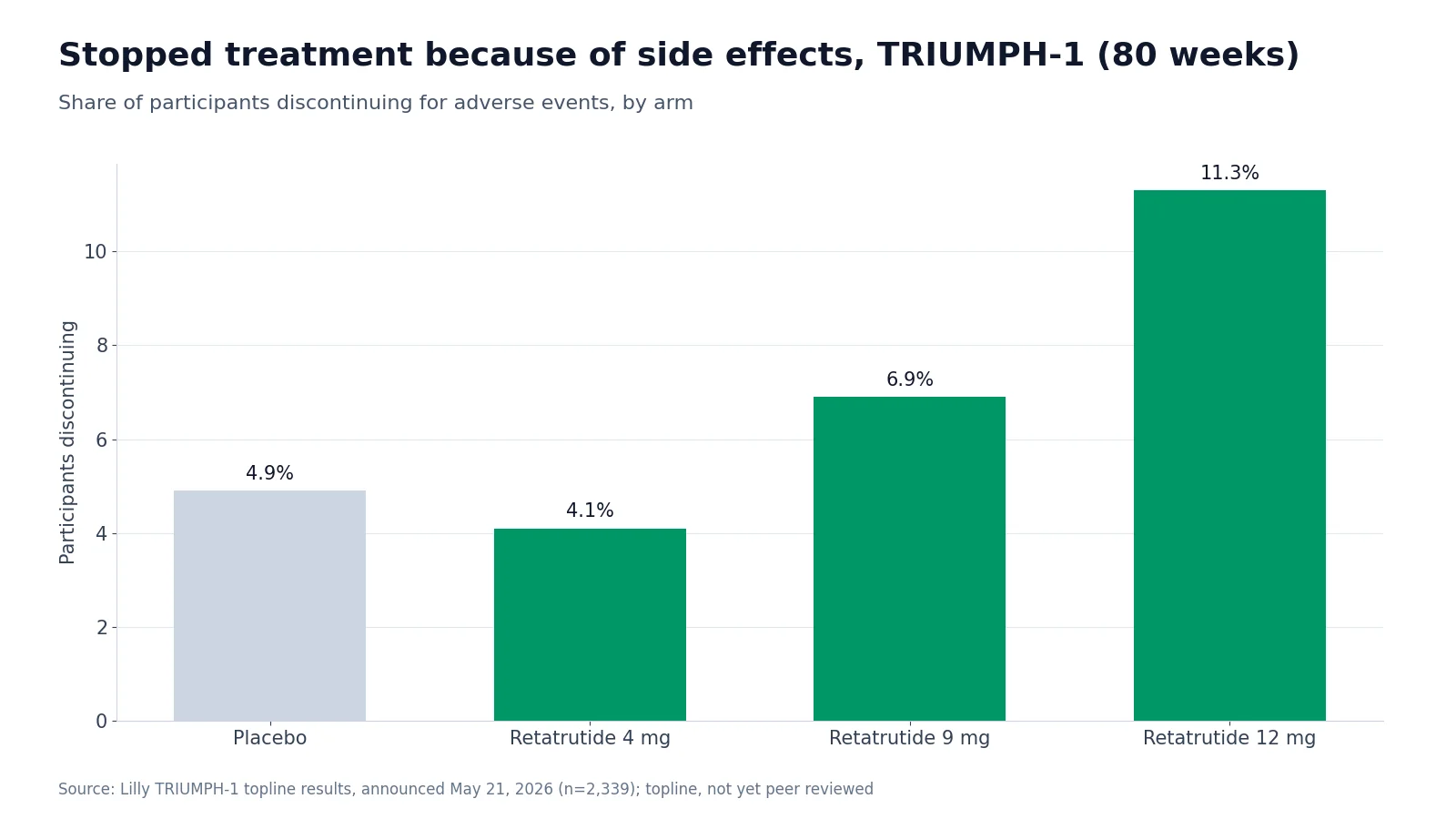
Higher efficacy has come with a visible tolerability cost at the top dose. In TRIUMPH-1, 11.3% of people on 12 mg stopped treatment because of adverse events, versus 6.9% on 9 mg, 4.1% on 4 mg and 4.9% on placebo. Nausea was reported by 42.4% on 12 mg versus 14.8% on placebo, and vomiting by 25.3% versus 4.8%. Dysesthesia, an abnormal skin sensation, was reported by 12.5% on 12 mg and 0.9% on placebo.
The tirzepatide label lists the same gastrointestinal family of side effects, with nausea, diarrhea and vomiting the most common. We are not putting a tirzepatide dropout figure beside the retatrutide one, because the trials differ in length, escalation and population, and an invented side-by-side would mislead. Our own retatrutide side effects guide goes deeper on the symptoms people report.
Dosing: a label schedule vs a trial schedule
Zepbound and Mounjaro have an FDA-approved schedule. Both start at 2.5 mg once weekly for four weeks, a dose meant only to start treatment. Doses then rise in 2.5 mg steps, with at least four weeks on each. For weight reduction the Zepbound maintenance doses are 5 mg, 10 mg or 15 mg, for sleep apnea 10 mg or 15 mg, and the maximum is 15 mg. Mounjaro's maximum is also 15 mg weekly for adults and 10 mg for children.
Retatrutide has no approved schedule. In TRIUMPH-1 participants began at 2 mg weekly and stepped up every four weeks to a target of 4 mg, 9 mg or 12 mg, under trial supervision. That is a research protocol, not a dosing instruction, and the intermediate steps are not something we can verify from public material. Our retatrutide dosage guide explains what is and is not known.
Access: the prescription market vs the research market
This is the section that decides most real choices. A tirzepatide prescription comes with a clinician who checks whether it suits you, a pharmacy that dispenses a product made to FDA standards, a label, and a route to report problems. A telehealth programme bundles those; our reviews of 35 programmes and cost comparison by state show what that bundle costs across providers, and the figure you were quoted is the one to check against them.
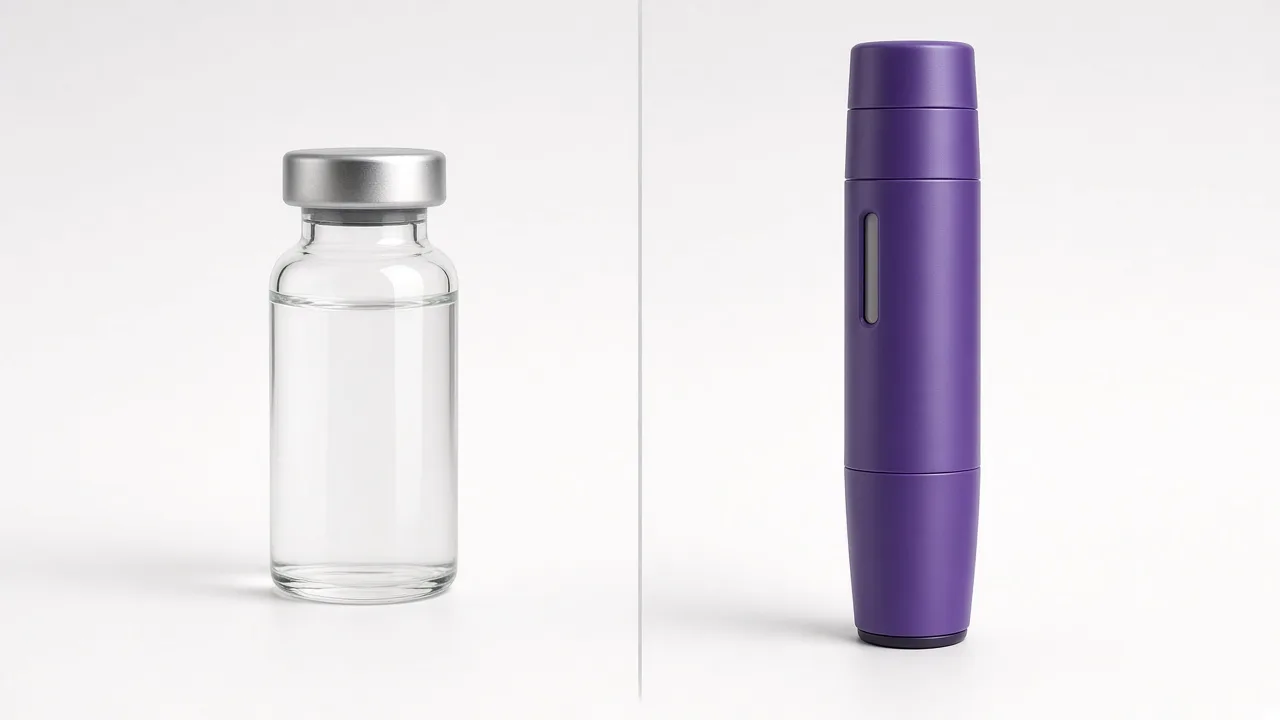
Retatrutide on the market today is something else: a research-labelled vial with no prescriber, no label and no regulator behind it. Lilly has publicly called on platforms and regulators to shut down what it describes as an illegal retatrutide black market. The only lawful way to receive retatrutide as a patient is inside a clinical trial. That is a hard fact to square with the volume of people searching for it, and we would rather say it plainly.
If you have decided to look at the research route anyway, one place that sets out what to check before you pay is Middleway Nutrition's retatrutide buying guide. Read it as a checklist, not a recommendation: it cannot make a research product into a medicine. We explain how we handle outside links on our affiliate disclosure page.
What is still unknown, and how to choose
Four gaps matter before any of the numbers above can be treated as settled. First, the phase 3 results are topline announcements from Lilly. Full datasets, with the statistical detail, were still to be presented at medical meetings and published when we checked, and one trade outlet noted that Lilly had not shown its statistical analysis for TRIUMPH-2 and TRIUMPH-3.
Second, long-term safety is thin. The trials run 68 to 80 weeks, with a pre-specified extension to 104 weeks in people with a baseline BMI of 35 or higher, and the tirzepatide label rests on a much larger body of evidence, including years of real-world prescribing. Third, we do not know the final approved dose schedule, the label wording, the price or the brand name, because none exists yet.
Fourth, the efficacy gap itself is indirect. A head-to-head trial against tirzepatide would settle it, and until one is reported the fair reading is that retatrutide looks stronger on average weight loss, with a heavier tolerability cost at the highest dose. That is a reasonable expectation to watch, not a result to buy on.
If you want weight loss under medical supervision today, the real comparison is Zepbound against Wegovy and the other approved options, and our weight loss injections overview covers that. If your doctor prescribes for type 2 diabetes, Mounjaro is the tirzepatide product on that label.
If retatrutide is what you are drawn to, the useful move is to wait for what comes next: Lilly's FDA filing, planned for the first quarter of 2027, then a review, then a label with a real dose schedule and safety data. Filing is not approval, and no approval date or brand name has been announced. Until then, this is a trial drug.